Companies are increasingly reaching substantial scale before entering public markets. This has renewed interest in how unusually large initial public offerings, or mega IPOs, enter stock market indexes and what their inclusion could mean for index fund investors.


Although a newly public company may have a significant headline valuation, its initial effect on a diversified index fund may be modest. That is because index inclusion follows each benchmark provider’s methodology, and a company’s weight generally reflects the value of shares that public investors can buy and sell rather than its total valuation.

Why are mega IPOs attracting attention now?

Companies are generally staying private longer, supported by greater access to private capital. By the time they pursue a public listing, some may be larger and more mature than the typical IPO of the past.

There is no single, industrywide definition of a mega IPO. The term generally describes a newly listed company whose market value would place it among the largest publicly traded businesses. Individual index providers apply their own size thresholds, often by comparing the company with existing index constituents or market capitalisation breakpoints.

The emergence of these companies presents index providers with two important objectives:

  • Representativeness: Reflecting economically significant companies once they become part of the public market.

  • Investability: Ensuring that the shares included in an index can reasonably be purchased and traded by investors.

Waiting several months to add a very large public company could leave an index temporarily less representative of its market. Adding it too quickly, however, could raise concerns about available liquidity, price formation, and the accuracy of ownership data. Index methodologies seek to balance these considerations through transparent eligibility and implementation rules.

When do IPOs enter stock market indexes?

There is no universal timetable. An IPO must satisfy the rules of the specific benchmark, which may address company size, liquidity, public float, domicile, security type, listing venue, and trading history.

Under a traditional inclusion process, an IPO may wait until a scheduled quarterly, semiannual, or annual index review. Some methodologies also require a minimum period of public trading, often called a seasoning period.

Fast-entry rules allow certain large IPOs to enter sooner. Depending on the benchmark, a qualifying IPO may be included approximately five to 15 trading days after listing. Approaches vary across index providers and even among indexes maintained by the same provider. For example, certain broad-market indexes permit fast entry, while the S&P 500 continues to require a longer trading history and satisfaction of its other eligibility criteria. 

A mega IPO does not receive automatic index inclusion because of its size, visibility, or expected performance. It must still meet the benchmark’s applicable eligibility requirements.

How large a weight will a mega IPO have in an index fund?

The answer generally depends more on the company’s float-adjusted market capitalisation than on its total valuation.

Free float refers to shares available for public investors to buy and sell. Shares held by founders, employees, controlling owners, governments, or other strategic investors may be excluded or discounted when an index provider calculates a company’s investable weight.

Essentially, float-adjusted market capitalisation equals the share price multiplied by the total number of publicly available shares.

Consider a hypothetical company with a total market value of $500 billion. If only 5% of its shares are considered publicly available, its initial float-adjusted market capitalisation will be approximately $25 billion. Its index weight will generally be based on that investable value, not the full $500 billion valuation. 

Investable size and index methodology matter more than headline valuation, with exposure generally building as public ownership expands. 

Note: The example is illustrative only and is based on the factors stated. It should not be taken to contain or provide an estimate or forecast of the size, valuation or index weighting of any company.

Why can the weight change over time?

The number of shares available to public investors often increases after an IPO. 

Lock-up agreements may temporarily prevent founders, employees, and early investors from selling shares. As restrictions expire, or as a company completes follow-on offerings and secondary sales, additional shares may become publicly available. This can increase the company’s float-adjusted market capitalisation and its index weight.

Index providers may reflect these changes during scheduled reviews or after qualifying corporate events. Significant float increases may also be incorporated gradually to support orderly trading and benchmark replicability.

As a result, the expiration of lock-ups and subsequent float adjustments may have a greater portfolio effect than the IPO’s initial index inclusion.

How do portfolio managers incorporate mega IPOs?

Inclusion is rules-based, but adding a large IPO to an index portfolio involves more than purchasing shares at the close of trading on the inclusion date. Portfolio managers must balance benchmark alignment with liquidity, transaction costs, market impact, taxes, and the potential for later float changes.

Portfolio managers may obtain exposure through a combination of IPO allocations, secondary-market purchases, fund cash flows, and carefully timed trading. The specific approach depends on the benchmark, available liquidity, relative pricing, and the fund’s investment objective.

The index provider determines whether and when a company enters the benchmark. The portfolio manager’s role is to implement that change efficiently. Vanguard’s scale, experienced investment teams, and disciplined trading processes support the incorporation of index changes while seeking tight tracking and low implementation costs.  

What should index fund investors remember?

Mega IPOs can generate significant attention, but their effect on a diversified index fund may be more measured than headline valuations suggest.

Three principles can help investors put mega IPOs and their index inclusion in perspective:

  1. Index inclusion is rules-based. A company enters an index when it satisfies the benchmark’s methodology, not because of investor enthusiasm or expected performance.

  2. Investable size matters. A company with a large total valuation but limited public float may initially receive a modest index weight.

  3. Diversification limits dependence on a single company. A broad index fund provides exposure to the development of public markets without requiring investors to predict which individual IPOs will succeed.

For long-term investors, the central principle remains unchanged: Broad, rules-based indexes seek to represent the market that investors can access. As public ownership of a newly listed company expands, its index representation can expand with it.

Notes: 
This article contains factual information only that is of a general nature. It does not contain financial product advice. We have not taken your objectives, financial situation or needs into account when preparing the information so it may not be applicable to your circumstances. 

All investing is subject to risk, including the possible loss of principal. Diversification does not ensure a profit or protect against a loss. An index fund is subject to the risks of the market or markets it tracks, and its value may rise or fall.

Source: Vanguard
Reproduced with permission of Vanguard Investments Australia Ltd
Vanguard Investments Australia Ltd (ABN 72 072 881 086 / AFS Licence 227263) is the product issuer. We have not taken yours and your clients’ circumstances into account when preparing this material so it may not be applicable to the particular situation you are considering. You should consider your circumstances and our Product Disclosure Statement (PDS) or Prospectus before making any investment decision. You can access our PDS or Prospectus online or by calling us. This material was prepared in good faith and we accept no liability for any errors or omissions. Past performance is not an indication of future performance.
© 2026 Vanguard Investments Australia Ltd. All rights reserved.
Important: Any information provided by the author detailed above is separate and external to our business and our Licensee. Neither our business nor our Licensee takes any responsibility for any action or any service provided by the author. Any links have been provided with permission for information purposes only and will take you to external websites, which are not connected to our company in any way. Note: Our company does not endorse and is not responsible for the accuracy of the contents/information contained within the linked site(s) accessible from this page.


 

Find unclaimed money

There is around $3 billion in lost shares, bank accounts and life insurance. You may have money that has not been claimed.

Important: Can’t see an address? Only limited address information is displayed on public unclaimed money records. If you think you have a legitimate claim to a record of money, you will need to provide proof of any addresses in the listed suburb.

Claiming money is a free service

Finding unclaimed money is a free service provided by the Australian Government.

There are services that can help you claim, but they follow the same process as if you claim yourself. They may also charge you a fee.

If you do choose to use a claim service, make sure the person you work with is a registered professional, such as a lawyer, accountant or financial adviser.

Using a registered professional gives you more protections, as it means they:

  • Are registered with a professional association

  • Must meet educational, experience and ethical standards

  • Are subject to codes of conduct and disciplinary action

Why has my money become unclaimed?

The Australian Government has laws to ensure that if money is identified as ‘unclaimed’, it can be returned to the rightful owner.

Under the unclaimed money laws, organisations are required to send unclaimed money to the Australian Securities and Investments Commission (ASIC). ASIC maintains the unclaimed money records and assists in the process to reunite unclaimed money to the rightful owners. Unclaimed money sent to ASIC is transferred to the Commonwealth of Australia Consolidated Revenue Fund.

Money may become unclaimed for the following reasons:

  • Bank accounts – if the account has been inactive (no deposit or withdrawals) for 7 years.

  • Life insurance policy – becomes unclaimed 7 years after the policy matures and is not claimed.

  • A company cannot contact a shareholder for more than 6 years.

  • A member of a managed investment scheme cannot be contacted for more than 6 years.

  • Money has been paid to a financial product provider for a financial product that cannot be issued and the money cannot be returned.

  • The money is the property of a deregistered company, or property of a trust or superannuation fund where a deregistered company is acting as trustee.

  • There is unclaimed money after:

    • a compulsory acquisition of securities

    • the winding up of managed investment scheme

    • the liquidation of a company

Depending on the type of claim, ASIC or the relevant institution will process your claim. Lost money is available to be claimed at any time by the rightful owner and there is no time limit on claims.

Didn’t find any lost money?

If you think you still have lost money, contact the institution where you think you had it. All records received by ASIC are publicly displayed on this list. We do not have access to any other records held by other agencies or institutions.

You can search for other types of unclaimed money on other government websites:

  • Australian Taxation Office – Search for lost superannuation by registering for the Australian Taxation Office’s online services via myGov.

  • State government – Search State government websites for deceased estates, lost share dividends, salaries and wages, cheques, over-payments, proceeds of sale and more.

Interest paid on unclaimed money

Interest is paid on unclaimed money, calculated from 1 July 2013. Find out more about how interest is paid.

What is an Original Transaction Number (OTN)?

Each unclaimed money record is given a unique OTN. You will need this number to make a claim. The OTN will also help you relocate that record in future and will assist us if we need to discuss your claim.

What life insurance money is held by ASIC?

ASIC holds money from life insurance policies from insurance companies or friendly societies that have been unclaimed for 7 years after the policy matures. ASIC’s unclaimed money search database goes back to 1952 for life insurance companies and back to 2000 for friendly societies.

What bank account money is held by ASIC?

ASIC holds money from bank, credit union and building society accounts that have not been used in 7 years and contain a balance of $500 or more.  ASIC’s unclaimed monies online search database holds these bank records:

  • savings bank accounts – records from 1989 

  • trading bank accounts – records from 1959 

  • credit union and building society accounts – records from 1992.

If the account you are looking for was last accessed before 1992, contact the state or territory government’s office of state revenue or state treasury where the bank, credit union or building society was originally registered. For example, if the credit union or building society was registered in NSW, you will need to go to Revenue NSW.

What money under the Corporations Act is held by ASIC, and how can I claim it?

ASIC holds certain types of unclaimed money from companies, shares and investments when the rightful owner cannot be located or the money has not been claimed. This can include money from lost shareholders, deregistered companies, company liquidations, managed investment schemes and other situations covered by the Corporations Act. 

If you find your name on the MoneySmart Unclaimed Money Search and the record is listed as “Company money”, you can lodge a claim directly with ASIC. To claim, note your Original Transaction Number (OTN), complete the relevant claim form, and provide documents that prove your identity and entitlement to the money. ASIC will assess your claim and, if approved, pay the funds directly to you.

Where does the data come from?

The data shown in search results is supplied by various banks, building societies, credit union, life companies, friendly societies and registered Australian companies. ASIC does not make any guarantees regarding the accuracy, currency, or completeness of the data. For privacy reasons some information may be redacted.

Source: Moneysmart
Reproduced with the permission of ASIC’s MoneySmart Team. This article was originally published at https://moneysmart.gov.au/find-unclaimed-money
Important note: This provides general information and hasn’t taken your circumstances into account.  It’s important to consider your particular circumstances before deciding what’s right for you. Although the information is from sources considered reliable, we do not guarantee that it is accurate or complete. You should not rely upon it and should seek qualified advice before making any investment decision. Except where liability under any statute cannot be excluded, we do not accept any liability (whether under contract, tort or otherwise) for any resulting loss or damage of the reader or any other person.  Past performance is not a reliable guide to future returns.
Important: Any information provided by the author detailed above is separate and external to our business and our Licensee. Neither our business nor our Licensee takes any responsibility for any action or any service provided by the author. Any links have been provided with permission for information purposes only and will take you to external websites, which are not connected to our company in any way. Note: Our company does not endorse and is not responsible for the accuracy of the contents/information contained within the linked site(s) accessible from this page.

Disclaimer This service is provided solely for general information purposes. By providing this service ASIC does not provide legal or other professional advice. ASIC expressly disclaims any liability arising from use of the unclaimed money service. If you require legal or other expert advice or assistance, you should seek the services of an appropriately qualified professional.

Read our Privacy Policy ASIC uses the information you provide in the search to check for possible matches on the register. By accessing the register you agree to our handling of your personal information as set out in the ASIC Privacy Policy.

Terms and Conditions By using the search function to look for unclaimed money, you acknowledge you have read and agree to be bound by these terms and conditions. By accessing the unclaimed money search, you agree you will: Only use the information on the register for the purpose of searching and claiming an amount listed on the register; and Comply with any privacy legislation governing the use and disclosure of information from the register.


Spring has long been celebrated as the season of renewal. Trees bud, gardens awaken and nature quietly reminds us that growth continues, season after season.

Perhaps we should take the hint.

It’s natural to settle into routines. We shop at the same supermarket, holiday in familiar places, cook the same meals and choose activities we know we’ll enjoy. There’s comfort in familiarity and, ease in routine.

But comfort comes at a cost.

Our brains are designed to adapt. They’re wired so we can solve problems, learn from experience and respond to new situations. When we repeatedly choose the familiar, we ask less of our brains. Over time, opportunities for growth become fewer.

Your brain is built to change

That’s where the science of neuroplasticity offers an encouraging perspective.

For a long time, scientists believed the brain became largely fixed in adulthood. We now know that’s not the case. Throughout our lives, the brain retains the ability to form new neural connections in response to learning and experience.i Every time we master a new skill, navigate an unfamiliar environment or tackle a challenge that requires sustained effort, the brain is strengthening and reshaping its networks.

The key word is effort.

Neuroplasticity isn’t driven by doing what comes easily. It thrives when we’re challenged, when we have to concentrate, make mistakes, adapt and try again. The very experiences we often avoid because they’re uncomfortable are often the ones that provide the greatest benefit.

In many ways, the friction is the point.

Why novelty feels so rewarding

There’s another reason trying something new can feel surprisingly energising.

Novel experiences activate the brain’s reward system, including the release of dopamine, a neurotransmitter that plays an important role in motivation, attention and learning. Rather than simply making us feel good, dopamine helps signal that something is worth paying attention to. It increases our readiness to learn and encourages us to repeat behaviours that challenge and reward us.ii

It’s one reason why mastering even a small part of a new skill can feel so satisfying. That sense of progress motivates us to keep going, creating a positive cycle where curiosity leads to learning, learning builds confidence and confidence encourages us to embrace the next challenge.

Resilience is built through challenge

Whether it’s learning a language, taking up a hobby, using new technology or travelling somewhere unfamiliar, the process can feel awkward and frustrating. But that mental effort is doing important work. It’s encouraging the brain to remain flexible, adaptable and engaged.

Research also suggests that regularly challenging the brain helps build what scientists call cognitive reserve. This refers to the brain’s ability to adapt to age-related changes by drawing on alternative neural pathways. While no single activity can prevent cognitive decline, maintaining a mentally active lifestyle is associated with better cognitive health and resilience as we age.

The benefits don’t stop with the brain

Trying new things also strengthens psychological resilience. We often think of resilience as something we call upon during major life events, but it is equally shaped by the smaller challenges we encounter every day.

Each time we become a beginner, we practise tolerating uncertainty. We discover that it’s okay not to have all the answers straight away. We learn to work through frustration instead of avoiding it. Over time, those experiences build confidence, not because the task becomes easier, but because we become more comfortable with being challenged.

Nature doesn’t burst into bloom because conditions are effortless. Growth follows a season of dormancy and requires energy, adaptation and resilience.

We’re not so different.

Growth rarely happens when life feels comfortable. It happens when we choose to stretch ourselves, whether that’s enrolling in a course, joining a walking group, volunteering, learning an instrument or simply saying yes to an experience we’ve never had before.

None of these moments will change us overnight. Together, however, they reinforce something powerful. Our capacity to learn, adapt and grow doesn’t and shouldn’t disappear with age. Like the seasons, it continues throughout life, provided we keep giving it the opportunity.

This spring, while you’re tending the garden or enjoying the longer days, consider planting something else too. A new skill. A new experience. A new challenge. To fuel your growth.

i Conceptualizing functional neuroplasticity | Science direct
ii
The Science of Novelty | Psychology Today

It was pitched to investors as “the biggest initial public offering (IPO) in a generation”.

Firmus Technologies – a developer of artificial intelligence (AI) data centres – planned to raise A$7 billion from investors on the Australian Securities Exchange.

Recently, bankers working on the deal declared investor interest in the A$11-a-share offer was “well in excess” of what was needed to go ahead.

The company and its backers claimed Firmus was worth almost A$44 billion, which would have made it Australia’s second-largest share market listing, behind Telstra in 1997.

Then, it was off.

What went wrong? And what are the lessons investors should apply to all companies to guard against hype and protect their money?

The warning signs were obvious

There were plenty of red flags ahead of this listing, covered in detail by The Conversation, when the IPO was still meant to be going ahead.

Firmus is losing money. Only two of its data centres are currently operational, with the rest in the planning or construction phase.

Most remarkably, Firmus’ claimed value had soared almost eight-fold in less than a year.

In November 2025, a private funding round valued it at about A$6 billion. In August this year, it had climbed to more than US$10.5 billion (about A$15 billion).

Yet, Firmus declared its value was A$43.7 billion. At that price, Firmus would have been worth almost as much as retail giant Woolworths.

A sign of the market working

The role of the market is to digest a lot of information and price all of that into a reasonable value for each company. If investors believe a company is worth less than its IPO price estimate, they withdraw their interest.

In Firmus’ case, this declining interest from investors seems to be an example of the market working properly.

We never saw a public prospectus with all the details about this listing and Firmus’ financials; it was meant to be released, but it wasn’t.

However, a draft prospectus was being circulated to institutional investors here and overseas. They’ve looked at that – and the prospect of actually committing to buying those shares at A$11 a share – and many have decided “no thanks”.

That’s why the listing was withdrawn.

Look for the incentives behind any claim

As an economist, you always look out for incentives: why would someone say something? What might be in it for them?

There is a clear incentive for investment bankers to ramp up demand before any stock exchange listing. That’s because the higher the float price, the more they pocket, too.

So where did this demand go? It’s quite possible there was strong initial demand for Firmus shares, but it was only indicative. That usually comes down a bit before any listing – or down by a lot, as in Firmus’ case.

Some commentators have raised a more concerning possibility: that the level of investor demand in Firmus may have been misrepresented.

After the Firmus listing was cancelled, The Australian Financial Review reported:

While demand for IPOs can move around, serious questions need to be asked about the sheer scale of the evaporation of orders from investors, or whether the communications were misleading to create the perception of frenzied support. The onus is now on the Australian Securities and Investments Commission to come down hard on those flouting the rules.

We’ll have to see what emerges in coming weeks on this.

Is it a warning sign of an AI bubble?

Investors shouldn’t assume that Firmus’ issues are indicative of every other AI or data centre company.

A lot of this situation is specific to Firmus, including how quickly their quite outrageous valuation numbers ballooned in such a short time.

However, we did see similar things happening during the dot-com bubble a generation ago. Back then, a lot of companies were going public based on “thin air valuations” – projecting huge demand into the future, without the numbers to back it up.

That was echoed in what Firmus was doing now: operating with just 5% of data centre capacity up and running, while the remaining 95% they were talking about as underpinning their valuation hadn’t yet been built.

What are the lessons for investors?

Potential investors should look at the hard numbers as closely as they can.

If you can’t find out what a company’s revenue was in the past year, and where it expects its money will be coming from for the next five years, at least – that’s a red flag.

Of course, even if you have those figures, that doesn’t mean things won’t go wrong down the road. But understanding those key numbers is a must, before you ever invest.

The golden rules are to diversify your investment portfolio and try to minimise your fees. And if you are buying into a single company’s IPO, it’s safer to allocate limited amounts to those.

As a general rule: don’t invest in single stocks more than you can afford to lose.

Source: This article is republished from The Conversation

The Higher Everyday Living Fee, or HELF, is a new optional fee that lets aged care residents pay for a more premium experience, from better meals to in-room entertainment. It’s completely optional, and declining it shouldn’t affect the standard care you receive. This guide breaks down what HELF actually covers, how it’s priced, and the exact questions to ask your provider before you sign anything.

When comparing aged care homes, you might have come across the term Higher Everyday Living Fee (HELF). This is HELF, introduced in November 2025, and made to give aged care home residents the option of a more premium experience. But what is it, how much is it, and how does it affect you or your loved one?

What is HELF?

In simple terms, HELF is a fee for extra services in residential aged care homes. This includes “higher living” services like premium meals, in-room television services, Wi-Fi usage, just to name a few. It’s taken over the need for multiple fees at once, like the Extra Service Fee and Additional Service Fee.

Is HELF compulsory?

The good news is that it’s a completely optional fee, and you can choose whether you or your loved one is willing to pay for the premium service. If you don’t choose to pay for this option, you shouldn’t be forced or charged for it by a provider. 

What if I don’t want to pay for HELF? Will I get less than others?

As per the law, non-HELF-paying residents will not be given lesser living conditions. All residential aged care residents will receive standard high-quality care and services under the Aged Care Quality Standards and the Service List, but HELF-paying residents will simply receive additional benefits. 

Choosing not to pay for HELF won’t prevent you from finding a place in a home, but a specific room you’re interested in may come with the fee built in. When looking at a particular facility, ask for the fee, and your right to decline it, in writing. Providers should be transparent and clear about how HELF comes into play in their particular facility. 

How much is HELF?

HELF is also not a “one size fits all” service fee. Each establishment and its provider sets its own price and services, all at its own discretion. Prices vary between different aged care homes and sometimes between rooms in the same facility. It’s important to ensure that you know exactly how much the home will be charging you for your specific choices. 

Before agreeing to anything in writing, make sure you’re clear on what you’re signing 

Here are some questions to ask your provider to get a better picture of how it will affect you: 

  • How much is HELF for this particular provider?

  • What are the premium services that come with this fee for this particular provider?

  • Do I still have to pay it even if I don’t use all the services?

  • How often is HELF charged?

  • How much notice will I get if the price goes up?

HELF is one part of a much bigger picture. When selecting a residential facility, you will encounter basic daily fees, means-tested care contributions, and accommodation costs, with this new premium option potentially added to the mix. None of it needs to be worked out alone, and none of it needs to be decided on the spot.

Your checklist

  • Take the price list home. 

  • Ask for the details in writing. 

  • Compare a few homes before you choose. 

  • If a fee isn’t clear, ask again until it is.

Understanding a fee like HELF is just one step in finding the right home. With the right questions, and the right support, that step gets a lot easier to take.

Source: AgedCareGuide
Reproduced with permission of Care & Co Media. This article was originally published on https://www.agedcareguide.com.au/talking-aged-care/aged-care-101-what-is-higher-everyday-living-fee-helf Important: This provides general information and hasn’t taken your circumstances into account. It’s important to consider your particular circumstances before deciding what’s right for you. Although the information is from sources considered reliable, we do not guarantee that it is accurate or complete. You should not rely upon it and should seek qualified advice before making any investment decision. Except where liability under any statute cannot be excluded, we do not accept any liability (whether under contract, tort or otherwise) for any resulting loss or damage of the reader or any other person. Any information provided by the author detailed above is separate and external to our business. Our business does not take any responsibility for any action or any service provided by the author. Any links have been provided with permission for information purposes only and will take you to external websites, which are not connected to our company in any way. Note: Our company does not endorse and is not responsible for the accuracy of the contents/information contained within the linked site(s) accessible from this page.

Retirement confidence isn’t just about your nest egg, it’s about your plan

Do you know how much interest you pay on your mortgage?

Chances are you do. Like many homeowners, you may follow the Reserve Bank’s interest rate decision closely. You know what your repayments are, how much rates have risen over recent years and what that means for your household budget.

Now consider another question.

Do you know the fees you pay on your superannuation account?

For many Australians, superannuation is their second largest asset after the family home. Yet recent retirement research found that one in two of us would not feel confident explaining the fees charged on their super account.1 At the same time, almost two-thirds could not correctly identify the age at which you can access super.2

The contrast is revealing.

The issue isn’t that Australians don’t care about retirement. It’s that retirement often remains a future problem until suddenly it becomes a present one.

Why confidence isn’t just about money

When Australians think about retirement, the conversation usually starts with money.

How much super do I need? Will I be able to retire comfortably? Am I on track?

They’re important questions. Yet one of the clearest findings from our research is that retirement confidence isn’t just about how much you’ve saved. It’s also about whether you’ve started planning for the future you want.

Australians with a retirement plan are significantly more likely to feel confident about retirement than those without one. Nearly half of working-age Australians, however, have no retirement plan at all.3

Too many Australians see retirement as a distant milestone rather than a life stage worth planning for today. As a result, retirement preparation is often delayed until people feel they have enough time, enough money or enough knowledge to tackle it properly. For many, that moment never quite arrives. 

The research also suggests many Australians are navigating retirement largely on their own. Around one in three rely primarily on their own research when making retirement plans, while partners, family and friends are consulted more often than financial advisers.4 This highlights how important it is that Australians have access to clear, practical information that helps them make informed decisions about their future.

A different retirement awaits younger Australians

In today’s economic landscape, it’s never been more important for young Australians to plan for the future.

While many of today’s retirees own their homes outright, our research shows younger Australians increasingly expect to enter retirement with mortgage debt or while renting. Combined with longer life expectancies, rising housing costs may make it more expensive to maintain the retirement lifestyle they hope to enjoy.

Yet planning for retirement doesn’t need to start with spreadsheets or complex calculations. It can begin with a much simpler question: what kind of life do you want to live?

This research found Australians overwhelmingly view retirement as an opportunity to maintain their independence, enjoy good health, spend time with family and friends, and pursue leisure activities. In fact, these lifestyle aspirations consistently rank alongside financial security as key ingredients of a successful retirement.

So, where do you want to live? Will you continue working? What role will travel, health and family play in your future?

These are lifestyle questions before they’re financial ones. Yet they often provide the starting point for a meaningful retirement plan. Once people have a clearer picture of the retirement they want, they are better positioned to make the financial decisions that support those goals.

Make a start

Retirement planning is not a single decision made at the end of a career. It is a series of decisions made over many years, often starting with one small step.

Take small, practical steps towards your financial future.

Getting started can be as simple as checking your super account, understanding the fees you pay, or having a conversation with your partner about your future. Small actions can build understanding, confidence and ultimately help Australians feel better prepared for retirement.

To start your retirement journey, talk to us.

Footnotes:
1. How Australia Retires 2026, 14
2. How Australia Retires 2026, 12
3. How Australia Retires 2026, 22
4. How Australia Retires 2026, 24

Source: Vanguard

This article has been reprinted with the permission of Vanguard Investments Australia Ltd. Copyright Smart Investing™
Reproduced with permission of Vanguard Investments Australia Ltd Vanguard Investments Australia Ltd (ABN 72 072 881 086 / AFS Licence 227263) is the product issuer. We have not taken yours and your clients’ circumstances into account when preparing this material so it may not be applicable to the particular situation you are considering. You should consider your circumstances and our Product Disclosure Statement (PDS) or Prospectus before making any investment decision. You can access our PDS or Prospectus online or by calling us. This material was prepared in good faith and we accept no liability for any errors or omissions. Past performance is not an indication of future performance. © 2026 Vanguard Investments Australia Ltd. All rights reserved. Important: Any information provided by the author detailed above is separate and external to our business and our Licensee. Neither our business nor our Licensee takes any responsibility for any action or any service provided by the author. Any links have been provided with permission for information purposes only and will take you to external websites, which are not connected to our company in any way. Note: Our company does not endorse and is not responsible for the accuracy of the contents/information contained within the linked site(s) accessible from this page.

The capital gains tax (CGT) reforms have sparked debate about whether investors should favour income-producing investments over those focused on growth, in an effort to reduce their tax bill.

But a lower tax bill doesn’t necessarily lead to a better investment outcome.

New modelling of the reforms suggests that while higher-growth investments could face larger tax liabilities under the new rules, they may still leave investors with greater after-tax wealth over the long term.

Understanding the changes

Under the current rules, Australian investors who hold an asset for more than 12 months may be eligible for a 50% discount on capital gains.

From July 1, 2027, that approach will be replaced with an indexed cost-base methodology, designed to account for inflation when calculating taxable gains1. The proposal would also introduce a minimum tax rate of 30% on capital gains.

To understand how these changes could affect investors, here is a model of two hypothetical portfolios over a 20-year period.2

  • A higher-income portfolio generating 6% annual income and 4% annual capital growth.

  • A higher-growth portfolio generating 2% annual income and 8% annual capital growth.

Both portfolios were assumed to deliver the same total pre-tax return of 10% per year. The key difference is how those returns are generated. 

Different returns, different tax outcomes

The reforms produce very different tax outcomes for the two portfolios. Under the new rules, the higher-income portfolio is around $4,000 better off than under the current regime, while the higher-growth portfolio is about $29,000 worse off.


Portfolio

Current rules after-tax value

New rules after-tax value

Difference

Higher income
(6% income, 4% growth)

$180,448

$184,427

+$3,979

Higher growth
(2% income, 8% growth)

$234,906

$205,719

-$29,187

Note: The example is illustrative only and is based on the factors stated. It should not be taken to contain or provide an estimate, projection or guarantee of future investment returns or tax outcomes. 

The difference largely comes down to the relationship between capital growth and inflation. Investments with relatively strong capital growth generally benefit more from today’s 50% CGT discount, while lower-growth investments may benefit more from an indexation approach. Keep in mind a portfolio with greater exposure to growth assets would generally be expected to experience greater fluctuations and a higher risk of loss than a lower-growth portfolio.

However, tax is only part of the story. Despite facing a larger CGT bill under the new rules, the higher-growth portfolio still finishes with more after-tax wealth after 20 years, accumulating approximately $205,700 compared with $184,400 for the higher-income portfolio.

This is because a greater proportion of the higher-growth portfolio’s return remains invested and compounds over time. This highlights an important distinction: the investment that generates the lowest tax bill may not be the one that leaves you with the most money after tax. In some cases, paying more tax may simply be a by-product of generating higher returns. 

What about different markets?

This distinction may also be relevant when comparing different markets. Australian shares have historically delivered a larger portion of returns through income, while international shares have tended to generate more of their returns through capital growth. Under the reforms, those differences could lead to different tax outcomes, but investors should remain focused on total after-tax returns rather than tax outcomes alone. 

The bottom line

The CGT reforms could change the relative tax treatment of income and capital growth. While this modelling suggests lower-growth portfolios may benefit from an indexed cost base and higher-growth portfolios could face larger CGT liabilities, tax is only one part of the equation.

The modelling shows that even after paying more CGT, a higher-growth portfolio can still generate greater after-tax wealth over the long term because more of its return remains invested and compounds over time. However a higher growth portfolio would also increase the exposure to market fluctuations and a higher risk of loss.

The right portfolio will depend on an investor’s goals, risk tolerance and circumstances. Tax outcomes are not guaranteed and will vary between investors. Rather than focusing solely on minimising tax, investors should focus on maximising long-term after-tax wealth.


1. Note that if you had acquired assets prior to 1 July 2027, part of your capital gain may be subject to the CGT discount if it was held for at least 12 months; however this discount gain is deferred until you sell your asset.

2. The modelling assumes an Australian resident individual investor eligible for the CGT discount under the current rules and a $50,000 initial investment, a 20-year holding period, a marginal tax rate of 47%, annual inflation of 2.7%, reinvestment of after-tax income distributions reinvested annually, and payment of CGT at the end of the investment period. Investment fees, transactions costs and Medicare levy are not included.

Important Information
This article contains certain ‘forward looking’ statements. Forward-looking statements, opinions and estimates provided in this article are based on assumptions and contingencies which are subject to change without notice, as are statements about market and industry trends, which are based on interpretations of current market conditions. Forward-looking statements including projections, indications or guidance on future earnings or financial position and estimates are provided as a general guide only and should not be relied upon as an indication or guarantee of future performance. There can be no assurance that actual outcomes will not differ materially from these statements. To the full extent permitted by law, Vanguard Investments Australia Ltd (ABN 72 072 881 086 AFSL 227263) and its directors, officers, employees, advisers, agents and intermediaries disclaim any obligation or undertaking to release any updates or revisions to the information to reflect any change in expectations or assumptions. This article is not a substitute for tax advice; it has been prepared on a set of assumptions which may not be applicable to you. If you are in any doubt about your personal tax position, we recommend that you seek advice from a registered tax agent or a suitably qualified adviser.

Source: Vanguard
Reproduced with permission of Vanguard Investments Australia Ltd
Vanguard Investments Australia Ltd (ABN 72 072 881 086 / AFS Licence 227263) is the product issuer. We have not taken yours and your clients’ circumstances into account when preparing this material so it may not be applicable to the particular situation you are considering. You should consider your circumstances and our Product Disclosure Statement (PDS) or Prospectus before making any investment decision. You can access our PDS or Prospectus online or by calling us. This material was prepared in good faith and we accept no liability for any errors or omissions. Past performance is not an indication of future performance.
© 2026 Vanguard Investments Australia Ltd. All rights reserved.
Important: Any information provided by the author detailed above is separate and external to our business and our Licensee. Neither our business nor our Licensee takes any responsibility for any action or any service provided by the author. Any links have been provided with permission for information purposes only and will take you to external websites, which are not connected to our company in any way. Note: Our company does not endorse and is not responsible for the accuracy of the contents/information contained within the linked site(s) accessible from this page.

Teaching kids about money

Raising your kids to be smart with money gives them vital life skills.

Helping younger kids understand money

As a parent, you can shape your child’s relationship with money from an early age.


You don’t need to be a money expert to teach kids about money. Simple conversations at home and everyday moments can help kids understand where money comes from, where it goes, and how to use it wisely.

Money conversations change as kids grow. What works for a young child will be different to what works for a teenager. But regular conversations can help build confidence and financial literacy over time.

How you earn money

Talk about how you earn the money you spend. 

Explain that you get paid for the work you do. Then show your child how you use that money to pay for things your family needs, such as food, clothes, transport and housing.

As kids get older, you can also talk about banks, savings accounts and digital payments.

What’s the difference between needs and wants?

Talk about how you decide what to spend money on. 

Needs are things we need for everyday life, such as food, housing and clothing. Wants are things we would like to have but can live without.

When your child asks for something, talk about whether it is a need or a want. This helps kids think about spending choices before they buy.

Show your kids where money goes

There are plenty of everyday opportunities to teach your kids about money.

When you tap and pay

Kids often see people pay with cards, phones and smart watches.

Explain that tapping to pay still uses real money from a bank account. Each purchase leaves less money to spend or save.

While shopping

Shopping can help kids learn about price, value and choice.

You can:

  • compare prices on similar products

  • point out discounts and special offers

  • look for the unit price (for example, price per 100g) 

  • compare which item offers better value

  • talk about whether something is a need or want.

When paying bills

Show your child a household bill, such as an electricity, internet or mobile phone bill. 

Talk about what the bill covers and how you use your income to pay for it. This helps kids connect earning money with paying for everyday things.

Looking for ways to practise at home? You can use Moneysmart’s primary school lessons and activities with your kids at home. They cover topics like needs and wants, budgeting, saving and making spending decisions. Explore primary school lesson plans.

Help kids learn by doing

As kids get older, they learn more when they start making their own money decisions.

Giving kids some responsibility for money can help them build confidence and learn from small choices while the stakes are low.

Should kids get pocket money?

There is no right or wrong approach.

Some parents give pocket money each week. Others link it to certain jobs around the house, such as:

  • mowing the lawn

  • vacuuming the house

  • making school lunches

  • hanging out and bringing in the washing

  • packing and unpacking the dishwasher

  • washing the car

  • taking out the rubbish

  • walking the dog.

Do whatever works for your family and circumstances.

Having their own money can help kids practise spending, saving and making choices.

Encourage your kids to save

Learning to save is an important life skill.

Piggy banks work well for younger kids because they can watch their money grow. 

As kids get older, a savings account can help them learn about banking, saving and interest, including the power of compound interest.

There are also apps to help kids save money and develop good money habits.

How can kids save for a goal?

Help your child save for something they really want.

When they want to make an impulse buy, talk about the goal they’re saving for and how today’s spending might affect it. 

You can use a savings goal calculator to help them see how different choices affect their progress.

Plan an event together

Invite your child to help plan a birthday party, family outing or special activity. 

Work through the costs together and talk about what fits the budget. This helps kids practise planning, prioritising and making spending decisions.

Do a budget together

Talk through parts of the family budget with your kids. 

Show them how much money comes in and how you use it for things like food, bills, transport and savings. This can help them understand the cost of living and how planning ahead helps. 

If they are earning money, show them how to create their own budget using this budget planner.

Help your kids learn with the budget planner

Track their spending

When older kids start earning or receiving money regularly, they may feel tempted to spend it all at once.

Show them how to track their spending so they can see where their money goes. This can help them make more informed choices about spending and saving.

Share their money

Some families include giving as part of learning about money.

If your child wants to support a charity or cause they care about, talk about how donations can help others and how giving fits alongside spending and saving.

Help teens build money skills for adulthood

Money conversations don’t stop when kids become teenagers.

As young people gain more independence, parents can still play an important role. You can help them build confidence, understand risks and prepare for bigger money decisions.

What should teenagers know before their first job?

Getting a first job is an exciting milestone.

It’s also a good time to talk about:

For many teenagers, this is the first time they earn and manage their own money.

How can I help my teenager manage money?

Teenagers often start saving for bigger goals, such as a concert, a holiday, study costs, a car or moving out of home.

Help them set a savings goal, create a simple budget and track their spending. These money skills can help them make confident financial decisions later in life.

They can also use the budget planner or savings goals calculator to make a plan.

Saving for a car

Many teenagers save for a car as one of their first big money goals.

Talk about the full cost, not just the purchase price. This may include registration, insurance, fuel, servicing, repairs and loan repayments.

Comparing options and planning ahead can help them make a more informed decision.

How can I help my teenager avoid money mistakes?

Encourage your teenager to ask questions before signing up for new products or services. A quick conversation can help them understand the costs, risks and alternatives before they commit.

Teenagers and young adults often make more money decisions online.

Talk about things like:

These conversations help young people recognise risks and make informed decisions.

Keep the conversation going

As your teenager gets older, they’ll start making bigger money decisions. 

They might start asking questions about managing money while studying, buying a car, moving out of home, rental bonds and leases, or saving for a home.

You don’t need to have all the answers. But your guidance still matters.

Talking through options together can help them build confidence and make informed choices.

Source: Moneysmart
Reproduced with the permission of ASIC’s MoneySmart Team. This article was originally published at https://moneysmart.gov.au/family-and-relationships/teaching-kids-about-money
Important note: This provides general information and hasn’t taken your circumstances into account.  It’s important to consider your particular circumstances before deciding what’s right for you. Although the information is from sources considered reliable, we do not guarantee that it is accurate or complete. You should not rely upon it and should seek qualified advice before making any investment decision. Except where liability under any statute cannot be excluded, we do not accept any liability (whether under contract, tort or otherwise) for any resulting loss or damage of the reader or any other person.  Past performance is not a reliable guide to future returns.
Important: Any information provided by the author detailed above is separate and external to our business and our Licensee. Neither our business nor our Licensee takes any responsibility for any action or any service provided by the author. Any links have been provided with permission for information purposes only and will take you to external websites, which are not connected to our company in any way. Note: Our company does not endorse and is not responsible for the accuracy of the contents/information contained within the linked site(s) accessible from this page.

What is your ‘estate’?

Your ‘estate’ includes everything you own – your ‘earthly possessions’, if you will. It can include for example cash, property, cars, boats, furniture, jewellery, family heirlooms, art, shares and more.

What is estate planning?

This is where you decide what will happen to your belongings after you pass away. By leaving a clear set of ‘instructions’, you help make sure that the people you care most about aren’t faced with any unnecessary conflict or uncertainty.

Why is estate planning important?

Even if you don’t have much money or property, planning your estate is the best way to make sure that special belongings go to the people who will treasure them. Often, it’s these items that matter most.

Why an estate plan is a good plan

  • Your assets get passed on to beneficiaries that you choose. If you pass away without a valid will (and in turn, without a valid estate plan) you’re considered to have ‘died intestate’ and your assets get distributed according to your state’s inheritance laws—not your wishes.
  • If you leave kids behind, you decide who cares for them and how—not the courts.
  • You minimise the tax your beneficiaries may pay when they inherit your assets.
  • You reduce the risk of conflict between family and friends when you pass away.

What’s in your will?

Your will is a legal document that’s part of your estate plan. It outlines how you want your estate to be managed and how you want your assets to be distributed when you pass away.

If you have a fairly straightforward estate and know how you’d like to distribute it, you can easily write your will yourself. It’s as simple as buying a will pack from Australia Post and select news agencies, or downloading it online.

For more complicated estates, it might be a good idea to get advice from a solicitor or the Public Trustee. You can then appoint them to be your executor.

Your will checklist

Your will should:

  • clearly identify your beneficiaries
  • clearly identify your executor
  • have the right date on it
  • be signed correctly
  • be witnessed correctly
  • list exactly how you want your estate to be distributed to your beneficiaries (including any plans if they pass away before you)
  • be up to date.

Should you review your estate plan?

Life is never predictable, so it’s a good idea to update your estate plan when things change.

Why you might change your estate plan

  • You get married.
  • You get divorced.
  • You have kids.
  • Your partner, dependant or loved one passes away.
  • You experience financial hardship.

Other things to consider

Organising life insurance and a funeral plan can make things easier for your family later. Learn the ins and outs of life insurance, or find out about estate planning in more detail with ASIC’s Moneysmart guide.

Source: NAB
Reproduced with permission of National Australia Bank (‘NAB’). This article was originally published at https://www.nab.com.au/personal/life-moments/family/will
National Australia Bank Limited. ABN 12 004 044 937 AFSL and Australian Credit Licence 230686. The information contained in this article is intended to be of a general nature only. Any advice contained in this article has been prepared without taking into account your objectives, financial situation or needs. Before acting on any advice on this website, NAB recommends that you consider whether it is appropriate for your circumstances.
© 2026 National Australia Bank Limited (“NAB”). All rights reserved.
Important:
Any information provided by the author detailed above is separate and external to our business and our Licensee. Neither our business nor our Licensee takes any responsibility for any action or any service provided by the author. Any links have been provided with permission for information purposes only and will take you to external websites, which are not connected to our company in any way. Note: Our company does not endorse and is not responsible for the accuracy of the contents/information contained within the linked site(s) accessible from this page.

How well do we understand our money?

Most of us make financial decisions almost every day.

We decide whether to save or spend, how much of the mortgage to pay down, where to invest and, eventually, how to turn decades of savings into an income that can support us through retirement.

But how well do Australians understand the financial concepts and systems behind those decisions?

Vanguard’s How Australia Retires 2026 report surveyed more than 1,800 Australians and found that while older Australians showed higher financial knowledge than younger Australians, significant gaps remain across everything from basic investment concepts to superannuation and the retirement system.

And that’s important because financial literacy isn’t about becoming an investment expert. It’s about having enough knowledge to make informed decisions about your money throughout your life.

How would you fare on the ‘Big Three’ questions?

To measure financial literacy, we asked Australians three internationally recognised questions developed by researchers Annamaria Lusardi (Stanford University) and Olivia Mitchell (University of Pennsylvania), which have been used to assess financial knowledge around the world.

They’re designed to test three foundational financial concepts: interest, inflation and diversification.

Have a go at the following and see how you do:

  1. Suppose you put $100 into a zero-fee savings account paying a guaranteed 2% interest rate. You make no further deposits or withdrawals. How much would you have after one year?

  2. Imagine the interest rate on your savings account was 1% a year while inflation was 2%. After one year, would your money allow you to buy more than today, exactly the same amount, or less?

  3. True or false: Buying shares in a single company usually provides a safer return than buying shares in a number of different companies.

We’ll reveal the answers at the end of this article, but first, how did Australians fare in the How Australia Retires 2026 report?

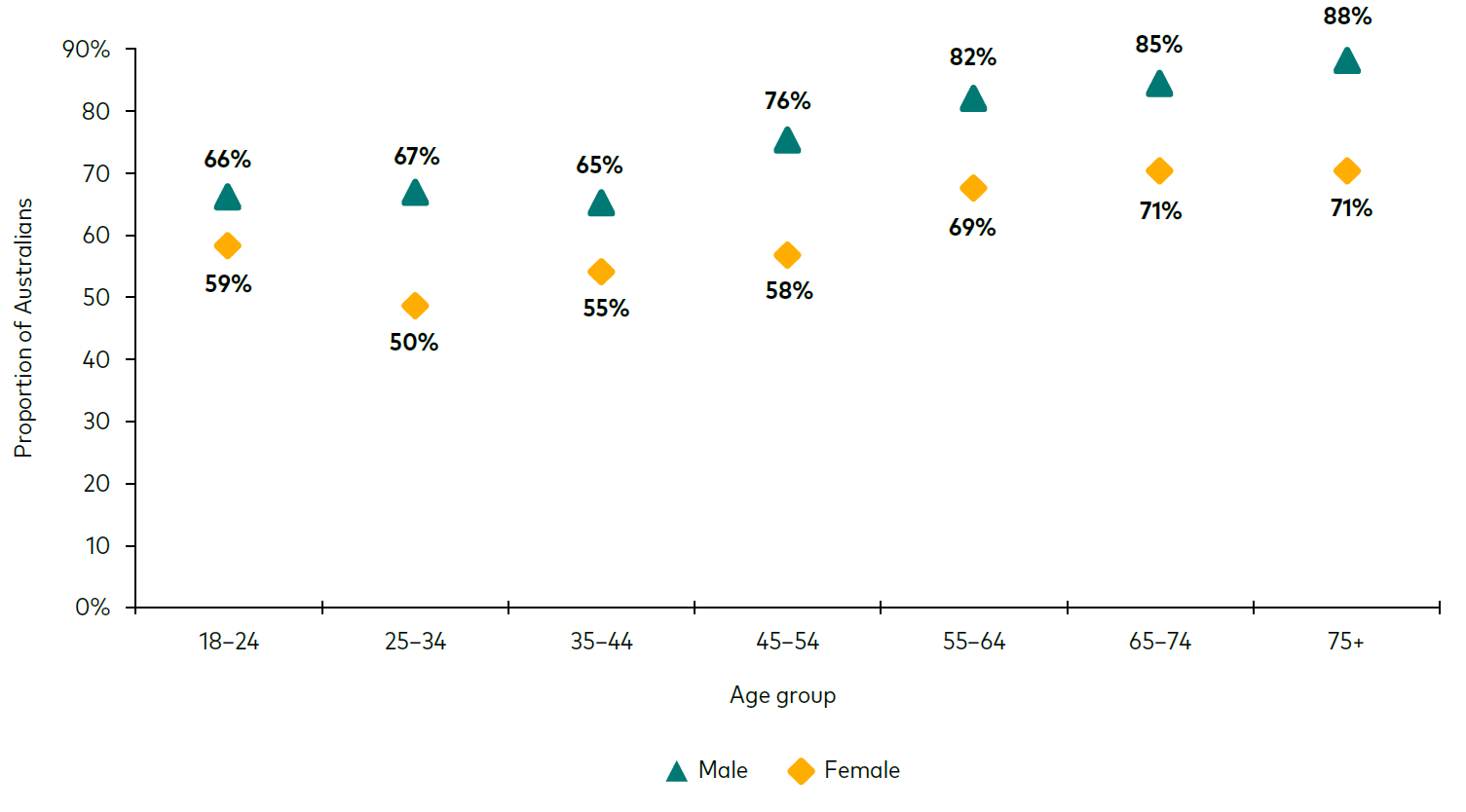
  • Financial literacy scores were generally higher among older Australians. Scores were relatively consistent among Australians aged 18-44 before rising substantially among older age groups. Men aged 55+ recorded average scores above 80%, with men aged 75+ achieving the highest score of 88%.

  • Younger Australians are improving. Men aged 18–24 scored 66%, up from 54% last year, while women in the same age group scored 59%, up from 50%.

  • The gender gap persists. Women scored below men across every age group, with the largest gap among 45–54-year-olds: 76% for men versus 58% for women.

 Financial literacy by age and gender

Source: Vanguard’s How Australia Retires Report 2026 (page 10).

Retirement knowledge remains a challenge

Understanding concepts such as inflation and diversification is one thing.

Navigating Australia’s retirement system is another.

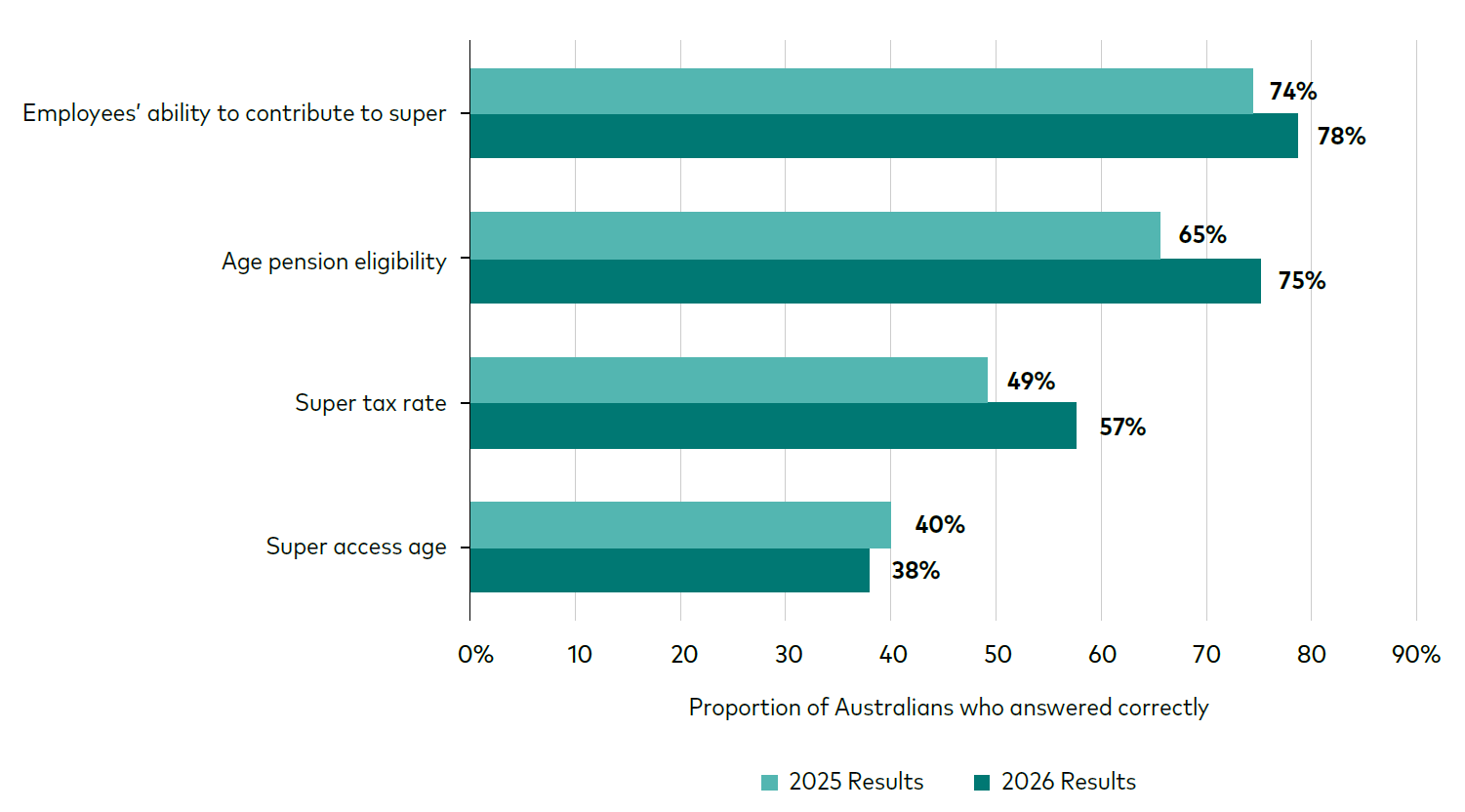
Respondents were asked four questions covering the Age Pension, voluntary super contributions, the taxation of super and when people can generally access their super savings.

The results were mixed.

  • Knowledge of voluntary super contributions improved. 78% correctly understood that employees can contribute to their own super, up from 74% last year.

  • More Australians understand Age Pension eligibility. 75% answered correctly, up from 65%.

  • Understanding of super’s tax treatment also increased. 57% answered correctly, compared with 49% last year.

  • Super access remains a major blind spot. Just 38% correctly identified the super preservation age, down from 40% last year. Among women aged 18–34, fewer than 30% answered correctly.

That’s a significant knowledge gap given super is likely to become one of the largest financial assets many Australians own.

Australians’ understanding of the retirement system

Source: Vanguard’s How Australia Retires Report 2026 (page 12).

How well do Australians understand their super?

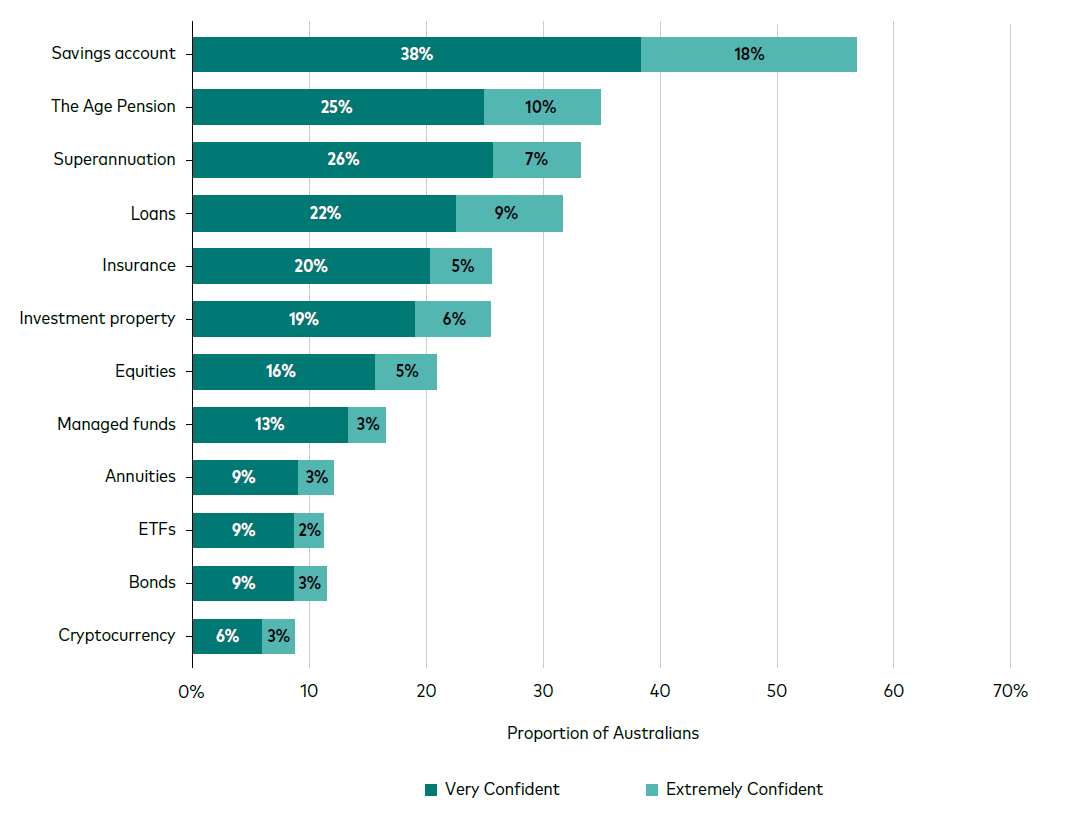
The research also asked the 1800 Australians surveyed how confident they felt about understanding different financial products.

Unsurprisingly, the humble savings account came out on top: 56% reported being very or extremely confident in their understanding.

But confidence dropped considerably for products that can play an important role in building and funding retirement.

Only around one-third of Australians reported high confidence in understanding superannuation, while confidence was even lower for equities, managed funds, ETFs, bonds and annuities.

More broadly, just 35% of Australians said they were very or extremely confident in making financial decisions, slightly below 37% last year.

Australians’ confidence managing financial products and services

Source: Vanguard’s How Australia Retires Report 2026 (page 13)

Fees are another area where knowledge could improve.

Nearly half of Australians said they wouldn’t feel confident explaining the fees charged on their super account to a friend or family member, while more than one-third weren’t very aware – or weren’t aware at all – that super funds may charge multiple fees.

Over long investment periods, even small differences in fees may have a significant impact on your investment balance. The extent of that impact will depend on factors such as investment returns, fees and your individual circumstances.

Vanguard’s modelling found that an additional 0.5 percentage points in annual fees could reduce the retirement balance of a hypothetical full-time worker by around $77,000, or approximately 12.5% of their accumulated savings under the assumptions used in the analysis.1

Building your financial knowledge

The good news is that financial literacy isn’t something you either have or don’t have.

It’s something that can be built gradually through reading, research, conversations and experience.

You could start with some of the fundamentals: understand how inflation affects your purchasing power, learn how compound returns work, explore the relationship between investment risk and return, and understand why diversification matters.

When it comes to retirement, make a habit of learning how your super works, how your savings are invested, what fees you’re paying and how the Age Pension fits into Australia’s broader retirement system.

Make a start

Australians are encouraged to take small, practical steps towards their financial future, whether it’s logging into your super account, learning something new about retirement or beginning to map out a plan. Now is a good time to take your first or next step in your retirement planning journey.

Access How Australia Retires 2026

1 Compares two hypothetical MySuper scenarios for a 25-year-old member with a starting balance of $24,004 and salary of $83,200, retiring at 67. Assumes 12% p.a. SG contributions (less 15% tax), 6.4% p.a. nominal returns, $173 p.a. life and TPD premiums and annual fees of 0.56% and 1.06%. Salary and premiums increase by 4.0% p.a. inflation (2.5% CPI plus 1.5% rising community living standards). End balances are shown in today’s dollars. This example is for illustrative purposes only.
Answers to financial literacy questions:
1. Exactly $102.
2. Less than today.
3. False.
Important information:
Source: Vanguard How Australia Retires 2026 research. Nationally representative survey of 1,800+ Australian adults aged 18 years and over in February 2026. The full methodology is available on page 62 of the report.
Note: Survey findings and examples are based on Vanguard’s How Australia Retires 2026 research and reflect respondents’ opinions, expectations and intentions at the time of the survey. They should not be taken as forecasts or predictions of individual retirement outcomes.
Source: Vanguard
Reproduced with permission of Vanguard Investments Australia Ltd Vanguard Investments Australia Ltd (ABN 72 072 881 086 / AFS Licence 227263) is the product issuer. We have not taken yours and your clients’ circumstances into account when preparing this material so it may not be applicable to the particular situation you are considering. You should consider your circumstances and our Product Disclosure Statement (PDS) or Prospectus before making any investment decision. You can access our PDS or Prospectus online or by calling us. This material was prepared in good faith and we accept no liability for any errors or omissions. Past performance is not an indication of future performance. © 2026 Vanguard Investments Australia Ltd. All rights reserved. Important: Any information provided by the author detailed above is separate and external to our business and our Licensee. Neither our business nor our Licensee takes any responsibility for any action or any service provided by the author. Any links have been provided with permission for information purposes only and will take you to external websites, which are not connected to our company in any way. Note: Our company does not endorse and is not responsible for the accuracy of the contents/information contained within the linked site(s) accessible from this page.